
INTODUCTION
Ticketing marketing is its own discipline. It is not quite ticketing and it is not quite marketing. It sits at the intersection of both and it draws on a skill set that neither profession fully develops on its own.
The ticketing professional understands platform architecture, inventory management, pricing mechanics and booking data. The marketing professional understands audience behaviour, campaign strategy, channel performance and brand communication. The ticketing marketing professional needs a working command of both, plus the specific skills that only exist at the point where they meet.
This is the gap that most training programmes miss entirely. General marketing qualifications build strong foundations in digital channels, consumer behaviour and campaign management. They contain almost nothing about ticketing systems, on sale strategy or how booking window data should drive marketing decisions. Ticketing-specific training, where it exists, focuses on platform operations and box office management. It rarely addresses the marketing skills needed to fill the venue.
For professionals working in marketing roles that are directly connected to ticket revenue, whether that is a head of marketing at a theatre, a digital marketing manager at a festival, a campaign lead at an immersive entertainment business or a ticketing strategy lead at a large-scale attractions group, the skill gap is real and the career cost of not closing it is measurable.
This guide maps the essential skills. Not as a wish list, but as a practical development framework for professionals who are serious about building genuine expertise at this intersection.

WHY TICKETING AND MARKETING HAVE CONVERGED INTO A SINGLE DISCIPLINE
There was a time, not long ago, when ticketing and marketing sat in separate departments with limited overlap. The box office managed inventory and sales. Marketing managed awareness and demand. They handed off to each other at predictable moments and operated largely independently the rest of the time.
That model no longer reflects how the most commercially effective experience economy organisations operate.
The reason is data. Modern ticketing platforms generate a continuous stream of commercially relevant information: booking velocity by session, conversion rates across price tiers, abandonment points in the checkout flow, party size distributions, advance booking windows by audience segment. That data is marketing intelligence. Organisations that route it to their marketing function and act on it in real time outperform those that treat it as a box office reporting function.
At the same time, marketing activity has become more directly measurable in its contribution to ticket revenue. Digital channels, attribution modelling and CRM integration mean that the connection between a specific campaign decision and its effect on sales can now be tracked with a precision that was not previously possible.
The result is a convergence. Marketing professionals need ticketing literacy to do their jobs well. Ticketing professionals who develop marketing capability become significantly more commercially valuable. And organisations that invest in professionals who can operate across both functions close the gap between marketing spend and ticket revenue faster than those that keep the two disciplines separate.
THE ESSENTIAL SKILL SET
1. Booking window literacy
Understanding how ticket sales distribute across the booking window is one of the most commercially important skills a ticketing marketing professional can develop. It is almost completely absent from general marketing training.
The booking window for a live experience is not uniform. Different audience segments book at different times relative to the event date. Group bookers tend to commit earlier. Spontaneous social plans convert closer to the date. Regular attenders have established booking habits. First-time visitors to a format they are unfamiliar with take longer to decide.
A marketer who understands this shapes their campaign accordingly. They know when to invest in awareness and when to shift spend toward conversion. They know which audience segments to prioritise at which point in the window. They know when early velocity data is a reliable signal and when it requires context before acting on it.
This is not a complex skill to develop with the right framework. It is an uncommon one because the training that builds it does not exist in general marketing education. Developing it early creates a structural advantage that compounds across every campaign you run.
2. Yield thinking applied to marketing decisions
Yield management is a well-established discipline in hospitality and aviation. In the experience economy, it is increasingly central to how commercially sophisticated organisations approach ticket sales. For marketing professionals, it is not about becoming a pricing specialist. It is about having enough yield literacy to make campaign decisions that serve the revenue goal, not just the awareness or engagement metric.
Yield thinking in a marketing context means being able to answer questions like: which price tier has healthy conversion and which needs support? Where in the booking window should promotional energy focus to optimise revenue per seat rather than just volume? When does a discounted offer stimulate genuine incremental demand and when does it simply bring forward a booking that would have happened anyway at a higher price?
These are questions that require marketing and commercial thinking to work together. The marketing professional who can hold both simultaneously, who can brief a campaign not just against reach and click targets but against a revenue contribution model, is operating at a level that most of their peers are not.
3. Data fluency across ticketing and marketing platforms
The data environment for a ticketing marketing professional spans two distinct systems that are rarely integrated as well as they should be. On one side, the ticketing platform: booking data, inventory status, session performance, price tier conversion. On the other, the marketing stack: paid media performance, email engagement, CRM segmentation, social analytics.
The skill is not technical expertise in any single platform. It is the ability to move between data sources, understand what each is telling you and synthesise across them to make better decisions. What does the ticketing platform data tell you about which sessions need marketing support this week? What does the email data tell you about which audience segments are most likely to respond to an early bird offer? What does the paid search data tell you about how far in advance different audience types are searching?
Professionals who develop this cross-platform data fluency become the people in their organisations who can connect marketing activity to commercial outcome with specificity. That is a rare capability and a career-defining one in the experience economy.
4. On sale campaign architecture
The on sale campaign is the most commercially critical piece of work a ticketing marketing professional will run. It is the opening of a selling window with a fixed close, and the decisions made in the weeks and months before it opens determine how well it performs.
On sale campaign architecture is a distinct skill set that includes:
Pre-on-sale demand building: how to warm an audience before tickets go live so that the opening of the booking window generates momentum rather than requiring it to be created from scratch.
Communication sequencing: how to plan the timing, targeting and content of communications across the full on sale period, from announcement through to final push, in a way that serves different audience segments at different points in their decision process.
Early bird and promotional mechanics: how advance pricing, limited allocations and time-sensitive offers affect booking behaviour across the full run, not just in the immediate period when the offer is live.
Live data response: how to read sales velocity data in real time and make campaign adjustments that serve the commercial outcome rather than just maintaining the original plan.
This is the skill that most directly separates strong ticketing marketing professionals from competent general marketers working in the sector. It is also the skill that is hardest to develop without structured, sector-specific training because there is no equivalent in general marketing education.
5. Pricing communication and scarcity management
How pricing and availability are communicated in marketing materials is a distinct skill that has direct commercial consequences. It is not copywriting. It is not pricing strategy. It sits between both.
The ticketing marketing professional needs to know how to communicate different price tiers in a way that guides audiences toward the right option rather than creating confusion or resistance. They need to know when and how to surface scarcity information in a way that drives conversion without manufacturing urgency that erodes audience trust. They need to understand how promotional mechanics, early bird pricing, last-chance offers and limited availability messaging affect not just immediate conversion but long-term booking behaviour across the run.
The core principle here is that honest scarcity, communicated clearly and at the right moment, is one of the most powerful tools available in experience economy marketing. The skill is knowing when it is real, how to frame it and when overusing it has begun to damage its effect.
6. CRM and audience segmentation for ticketed experiences
The audience database built through ticketing is the most commercially valuable marketing asset a live experience organisation has. Using it well requires skills that are different from standard CRM practice because the purchase cycle, the relationship structure and the data available are all specific to the sector.
In the experience economy, past booking behaviour is a better predictor of future attendance than almost any other signal. Someone who has attended three times in two years is a fundamentally different prospect to someone who attended once eighteen months ago and has not been back. Someone who books in groups of four is a different proposition to someone who always books solo. Someone who consistently buys at the highest price tier tells you something different about their relationship with the experience than someone who only buys when a promotion is live.
Building segmentation that reflects these distinctions, and writing communications that are relevant to each segment rather than broadcasting the same message to the full database, is the skill that transforms a ticketing database from a list into a commercial asset. It reduces the cost of acquisition, increases yield from existing audiences and builds the kind of relationship that generates repeat attendance and word of mouth.
7. Digital channel skills built for the booking journey
The digital marketing fundamentals apply in the experience economy as everywhere else. Paid social, search, email, organic content, analytics. These are table stakes. Every ticketing marketing professional needs a working command of them.
What separates strong ticketing marketers from competent general digital marketers is how those channel skills are applied in the specific context of a booking journey. Paid search for a live experience does not follow a standard conversion funnel. The decision to attend involves other people, which changes how social strategy should work. Email has a different relationship with timing and scarcity than in most other commercial contexts. And the booking journey itself, from first awareness through to post-purchase communication, has a specific emotional arc that the best ticketing marketers design for rather than ignore.
Answer Engine Optimisation is a more recent addition to this skill set but an increasingly important one. AI-driven search is generating direct responses to queries like best family experiences in Edinburgh this summer rather than returning a list of links. Structuring event content to appear in those responses is becoming a commercially meaningful skill for ticketing marketing professionals who manage digital discovery. The GIEM Experience Marketing Masterclasses covers this in the specific context of ticketed experiences. You can find out more about the curriculum at theGIEM.com.
8. Commercial communication with non-marketing stakeholders
This is a skill that is rarely named in skills guides but is consistently present in the professionals who progress furthest in ticketing marketing roles.
The ability to translate marketing activity into commercial language for producers, general managers, finance directors and boards is what determines whether the marketing function is seen as a strategic partner or an execution resource. It is the difference between being given a brief and being involved in shaping the commercial strategy that generates the brief.
In practice it means being able to present campaign performance not just in marketing metrics but in revenue contribution. It means being able to make the case for a particular promotional mechanic in terms of its effect on yield across the run, not just its effect on click-through rate. It means understanding enough about the P&L to have a credible conversation with the people who own it.
WHY THESE SKILLS ARE HARD TO DEVELOP THROUGH STANDARD TRAINING
The skills listed above have something in common. They are all specific to the commercial context of ticketed, time-bound live experiences. None of them are adequately covered by general marketing qualifications. Most of them are not covered at all.
General digital marketing training is built around scalable products, recurring revenue models and audiences that can be retargeted indefinitely. The mental models it develops, while genuinely useful as foundations, do not map onto a sector where inventory is perishable, campaign windows are fixed and the commercial logic is fundamentally different.
The result is that ticketing marketing professionals develop most of their sector-specific skills on the job, through trial and error, through conversations with more experienced colleagues and occasionally through industry events where relevant practice is shared. This is slow, inefficient and produces uneven results depending on the quality of the environment someone happens to work in.
Training that starts from the sector, that builds the specific skills of ticketing marketing from within the commercial context of the experience economy rather than asking professionals to adapt generic frameworks, is a significantly faster and more reliable route to competence. That is the principle the GIEM Experience Marketing Masterclasses is built on. Details of the curriculum and upcoming cohorts at theGIEM.com.
HOW TO DEVELOP THESE SKILLS DELIBERATELY
Identifying the skill gap is the first step. Closing it requires deliberate investment. A practical approach for ticketing marketing professionals at different career stages:
Early career
Focus first on booking window literacy and on sale campaign architecture. These are the skills that most directly affect your ability to contribute commercially from day one in a ticketing marketing role. Seek out every on sale you can be involved in, read the data actively rather than passively, and find senior colleagues who are willing to explain the commercial decisions behind the campaign choices they make.
Develop your digital channel fundamentals in parallel, but always with the question of how does this apply to a booking journey rather than treating platform skills as ends in themselves.
Mid-career
The skills that differentiate strong mid-career ticketing marketing professionals are yield thinking and data fluency across marketing and ticketing systems. These are the capabilities that allow you to operate at the intersection of marketing and commercial strategy rather than as a pure marketing execution function.
At this stage, structured professional development pays a higher return than it does at any other career point. You have enough operational experience to contextualise what you are learning and enough seniority to act on it immediately.
Senior level
The critical skill addition at senior level is commercial communication with non-marketing stakeholders. The ability to translate your function's contribution into revenue language, to make the case for strategic marketing investment in terms that resonate with producers and finance teams, and to position the marketing function as a driver of commercial strategy rather than a cost within it.
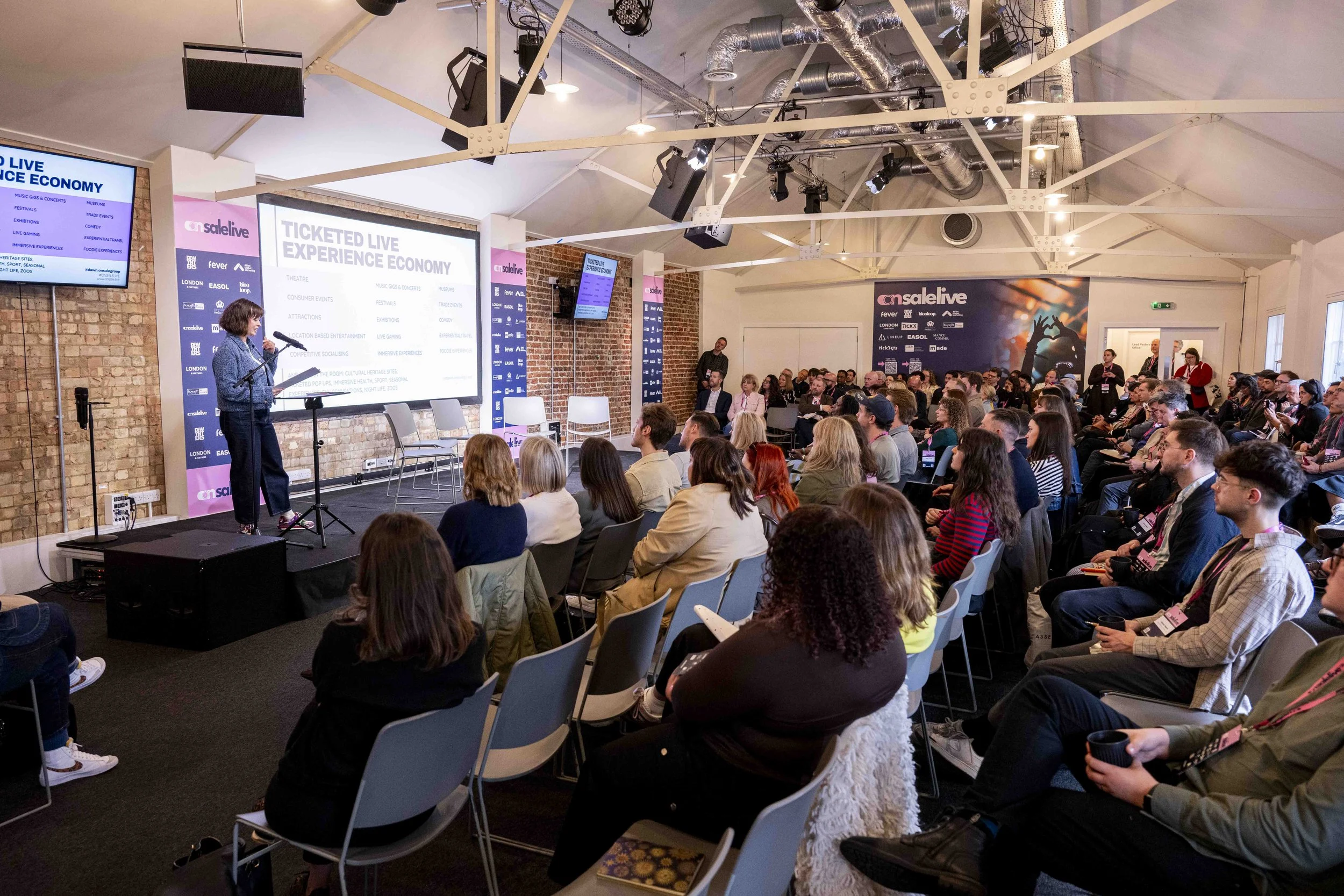
The peer network also becomes more important at senior level. The experience economy marketing community that gathers at On Sale Live: The Experience Economy Expo is where senior ticketing marketing professionals share current practice, compare approaches and build the relationships that matter over a career. If you are at a senior level and not yet connected to that community, it is worth prioritising.
Further reading and resources
For an understanding of the ticketing technology landscape and how platforms are evolving, Ticketing Technology Forum is a specialist event and knowledge resource for professionals working across ticketing systems and distribution. Understanding the technology that sits underneath the marketing operation gives ticketing marketing professionals a more complete picture of the constraints and opportunities they are working within.
For broader grounding in the commercial and operational context of the experience economy, IAAPA publishes industry research and benchmarking data that is directly relevant to ticketing marketing professionals working across attractions, themed experiences and large-scale live entertainment. Their data on attendance patterns, consumer spending and market trends provides useful commercial context for campaign and pricing strategy.
THE OPPORTUNITY IN FRONT OF THIS PROFESSION
Ticketing marketing is a profession that is becoming more commercially important as the experience economy grows and as the connection between marketing activity and ticket revenue becomes more precisely measurable.
The professionals who invest in developing the specific skills that sit at the intersection of ticketing and marketing are building a capability that is genuinely scarce. The experience economy is growing faster than the supply of people who understand how to market and sell within it. That gap is an opportunity.
The skills in this guide are not abstract. They are the practical capabilities that determine whether a marketing professional in a ticketing context operates as a strategic commercial contributor or as an execution resource. The difference between those two positions is significant, both in terms of career progression and in terms of the commercial impact you have on the organisations you work with.
Building them deliberately, through structured development combined with active engagement with the professional community, is the most direct route to the senior end of this profession.
The GIEM Experience Marketing Masterclasses is designed specifically for marketing and sales professionals in the experience economy who want to build the sector-specific skills, commercial frameworks and peer community that accelerate that journey. Full details at theGIEM.com.
BUILD YOUR TICKETING MARKETING SKILLS
The GIEM Experience Marketing Masterclasses covers on sale strategy, commercial frameworks, yield thinking, digital skills and AI-driven search, all taught in the context of ticketed experiences with a peer cohort from the experience economy. Details and upcoming cohorts at theGIEM.com.
Join the experience economy's annual marketing and ticketing expo: On Sale Live: The Experience Economy Expo at onsale.live.
For consultancy and strategic advisory on commercial marketing performance in the experience economy: dawnfarrow.com.